
If you only ever drive around Vancouver, you can skip winter tires. That part is true.
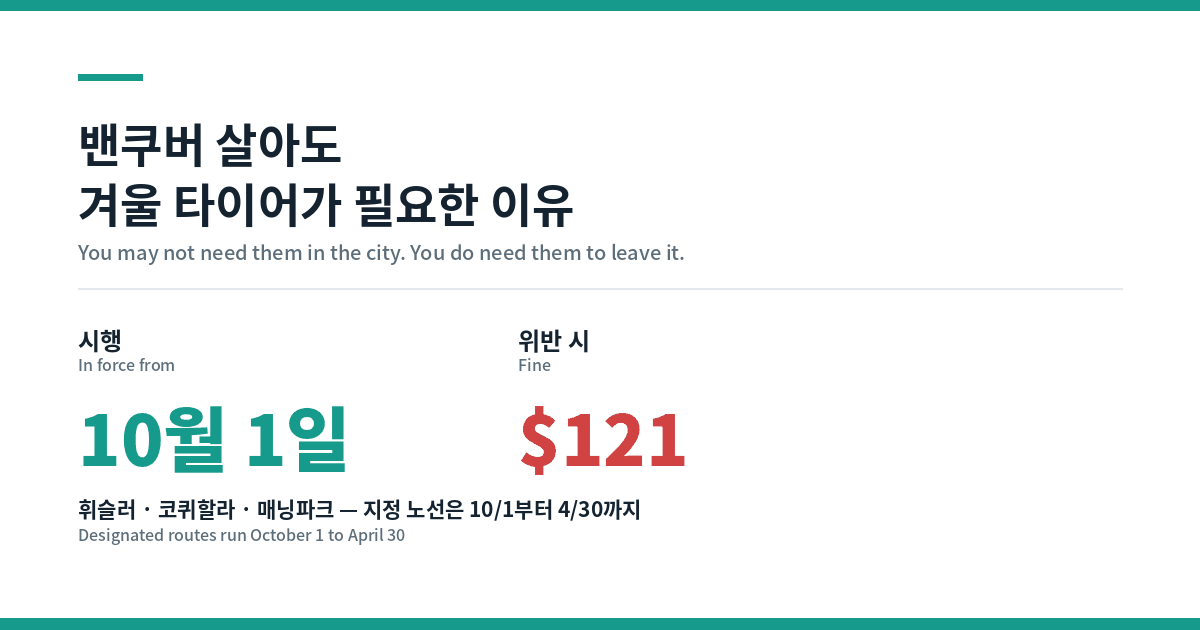
But from October 1, the road to Whistler, the road to Kelowna and the road to Kamloops all require them by law. Driving without them is a $121 fine, and you can be turned back at a checkpoint.
One ski trip, one visit to family in the Interior, one drive to Banff — the moment you leave the Lower Mainland in winter, this applies to you. Here is where the requirement starts, what counts as a legal tire, and how to keep the cost down.

Where the requirement starts

B.C. applies the rule only to designated routes. Winters are mild enough in the Lower Mainland and southeastern Vancouver Island that most of those roads are left out. That is where “you do not need them in Vancouver” comes from.
The catch is that almost every road leading out is designated.
| Where you are going | Route | In force |
|---|---|---|
| Whistler and the ski hills | Hwy 99 Sea to Sky (Squamish to Whistler) | Oct 1 – Apr 30 |
| Kelowna and the Okanagan | Hwy 5 Coquihalla (Hope to Kamloops) | Oct 1 – Apr 30 |
| Kamloops and points east | Hwy 5 Coquihalla | Oct 1 – Apr 30 |
| Manning Park and Princeton | Hwy 3 (Hope to Princeton, Allison Pass) | Oct 1 – Apr 30 |
| The Fraser Canyon | Hwy 1 (Hope to Lytton) | Oct 1 – Apr 30 |
| Victoria, over the Malahat | Hwy 1 Malahat | Oct 1 – Mar 31 |
The end date trips people up. Mountain passes and high-snowfall routes run to April 30; selected routes that do not cross a pass end March 31. The Malahat is the one most people meet. In April the Victoria run is done while Whistler is still enforced.
⚠️ The routes are signed. The requirement begins where the “Winter tires or chains required” sign stands. Not having noticed it is not a defence.
What counts as a legal winter tire

Two conditions, and you need both.
- The marking — the sidewall must carry either M+S (mud and snow) or the 3PMSF three-peak mountain snowflake. Both are legally valid.
- At least 3.5 mm of tread. The marking does not save a worn tire. This is where people get caught.
M+S and 3PMSF are equal in law but not on the road. M+S is the minimum, stamped on most all-seasons. The 3PMSF marking means the tire passed a snow traction test, and the province recommends it. All-weather tires carry it.
| Legal | Snow and ice | Notes | |
|---|---|---|---|
| M+S (all-season) | ✅ | Adequate | The minimum. Fine if you stay above freezing |
| 3PMSF (all-weather) | ✅ | Good | Run year round. The practical Vancouver choice |
| 3PMSF (dedicated winter) | ✅ | Best | Wears fast if left on through summer |
| Summer tires | ❌ | — | Chains are not a substitute |
Chains on summer tires do not count. That is written into the rules. Chains supplement winter tires; they do not replace them.
But I drive a 4×4
It makes no difference to the law. Even on a 4×4 you need at least two matching winter tires on the primary drive axle. Four is the recommendation.
Two is also a bad idea in practice. Mismatched grip front to rear is how a car spins in a corner. Fit all four.
When to switch — the temperature, not the date
The legal season opens October 1, but the number that should drive your decision is 7°C.
Summer and all-season rubber hardens below about 7°C. Grip drops even on dry pavement with no snow in sight. Winter rubber does the opposite: above 7°C it softens and wears quickly. So the trigger is not the first snowfall — it is when morning temperatures stop climbing back above 7°C.
In Metro Vancouver that usually lands somewhere between mid-October and early November. If you have a mountain trip booked before then, get it done sooner.
💡 Book in September. Shops fill up from mid-October, and the day a snowfall warning appears, same-day appointments are gone.
Cost — swap versus changeover

There are two ways to run winter tires here, and the difference matters every single year.
| What happens | Cost each year | |
|---|---|---|
| Swap | Winter tires live on their own rims; the whole wheel comes off and on | $50 – $100 |
| Changeover | Tires are dismounted and remounted on the same rims, then rebalanced | $100 – $200 |
A set of steel rims pays for itself. Saving $50 to $100 a year covers the rims in roughly five seasons, and because the tires are never dismounted you also avoid bead damage and repeated TPMS handling.
Run-flats, low-profile tires and TPMS reprogramming each add $20 to $50. Ask when you get the quote.
These are approximate ranges. Shops and vehicles vary.
Where to store them
- Shop storage — roughly $70 to $120 a season. The realistic option in a condo or apartment
- At home — somewhere cool and out of direct sun. Mounted on rims, stack them flat; loose tires stand upright
- A storage locker — no extra cost if you already rent one
So what should you actually buy
If you live in Metro Vancouver and head up the mountain a few times a winter, it comes down to two options.
| If this is you | Buy | Why |
|---|---|---|
| City driving, two or three mountain trips | All-weather (3PMSF), four of them | Legal on designated routes, and no seasonal swap or storage at all |
| Season pass, up the hill most weekends | Dedicated winter, four, on steel rims | The ice difference is real |
| Never leave the city | Keep your all-seasons | But check the M+S marking and the tread depth |
All-weather tires suit Vancouver well. They carry 3PMSF, so they are legal on designated routes, and they stay on year round. The trade-off is that on mid-winter ice they are still a step behind a dedicated winter tire.
Fines and enforcement
| Situation | Authority | Amount |
|---|---|---|
| Passenger vehicle without winter tires where required | Motor Vehicle Act s.125 | $121 |
| Commercial vehicle not carrying chains | s.7.1635 | $196 |
| Commercial vehicle bypassing an active chain-up area | s.208(4) | $598 |
The fine is the smaller problem. Being turned back is the real one. Stopped at the bottom of the Coquihalla, your day is finished — along with the lift tickets and the hotel booking.
There is an insurance angle too. If you crash while not meeting a legal requirement, it can weigh against you in how fault is assessed. A claim is not automatically refused, but it is a weakness you do not need to hand anyone.
What about studded tires
Legal in B.C. only from October 1 to April 30, and the studs must not protrude more than 2 mm. Leaving them on past the season is an offence.
For Metro Vancouver they are usually overkill — noisy on dry pavement and longer to stop on it. Unless you regularly drive icy Interior roads, skip them.
Before you set off
- Check the sidewall — is there an M+S or 3PMSF marking?
- Check the tread — 3.5 mm or more. Any tire shop will measure it for free
- Check all four — mismatched front and rear is more common than you would think
- Check pressure — a 10-degree drop in temperature takes pressure with it
- Check the road — DriveBC for conditions and any active chain-up
- Carry chains — worth having in the vehicle for mountain passes even with winter tires
Frequently asked questions
Q. What about a rental car?
Rental companies do not fit winter tires by default. You have to request them when booking, usually for a fee. If you are heading for the mountains, check the sidewalls yourself at pickup.
Q. My all-seasons say M+S. Is that legal?
Yes, provided the tread is 3.5 mm or more. On ice, though, a 3PMSF tire is clearly better.
Q. Can I fit just two?
Two on the drive axle is the legal minimum. It also raises your chance of spinning, because grip differs front to rear. Fit four.
Q. Do I have to switch back on May 1?
The requirement ends, but there is no rush. Use the same 7°C rule. Leaving winter tires on through the summer just wears them out faster.
Q. Is there an ICBC discount for winter tires?
No discount is given simply for fitting them. Other ways to lower your premium are covered in the article linked below.
The short version
- Metro Vancouver streets are exempt. Nearly every highway out of the city is not
- The season runs Oct 1 to Apr 30, or to Mar 31 on selected routes such as the Malahat
- M+S and 3PMSF are both legal, but you also need 3.5 mm of tread
- Chains on summer tires are not a substitute, and a 4×4 is not exempt
- Switch on 7°C mornings, not on a calendar date
- A second set of steel rims saves $50 to $100 every year
- Book in September. Shops are backed up from mid-October