
Registering a vehicle in BC means buying ICBC insurance first. But once you are sitting across from a broker, “what should I add on top of Basic?” is a hard question to answer. There are a lot of options and the terminology is unfamiliar.
This guide covers how BC auto insurance is structured and what to add, and why.
📅 Current as of August 2026. Coverage and rates change — confirm with ICBC or your broker before purchasing.
BC Auto Insurance Has Two Layers

Layer 1 — ICBC Basic (Autoplan Basic) Mandatory on every BC vehicle. You cannot register a car without it.
Layer 2 — Optional Coverage layered on top. Here is the fact most newcomers do not know:
Optional coverage does not have to come from ICBC. Private insurers licensed in BC — BCAA, Intact, Wawanesa, Square One and others — sell it too, and often for less.
Basic is an ICBC monopoly. Optional is a competitive market. Not knowing the difference can cost you hundreds of dollars a year.
Enhanced Care — the Current Model
Since 2021, BC has operated a care-based (no-fault) model called Enhanced Care.
The core idea is that treatment and income-loss benefits are paid regardless of fault. In exchange, the circumstances in which you can sue are substantially restricted.
The transition cut average premiums by about $496 (roughly 28%), and five rebates totalling $640 have been issued since. Basic rates have not increased in seven consecutive years, and the freeze now extends through 2027.
So the basic rate environment in BC is genuinely favourable right now. The exposure is in what Basic does not cover.
What Basic Covers — and What It Does Not

Included
| Coverage | Detail |
|---|---|
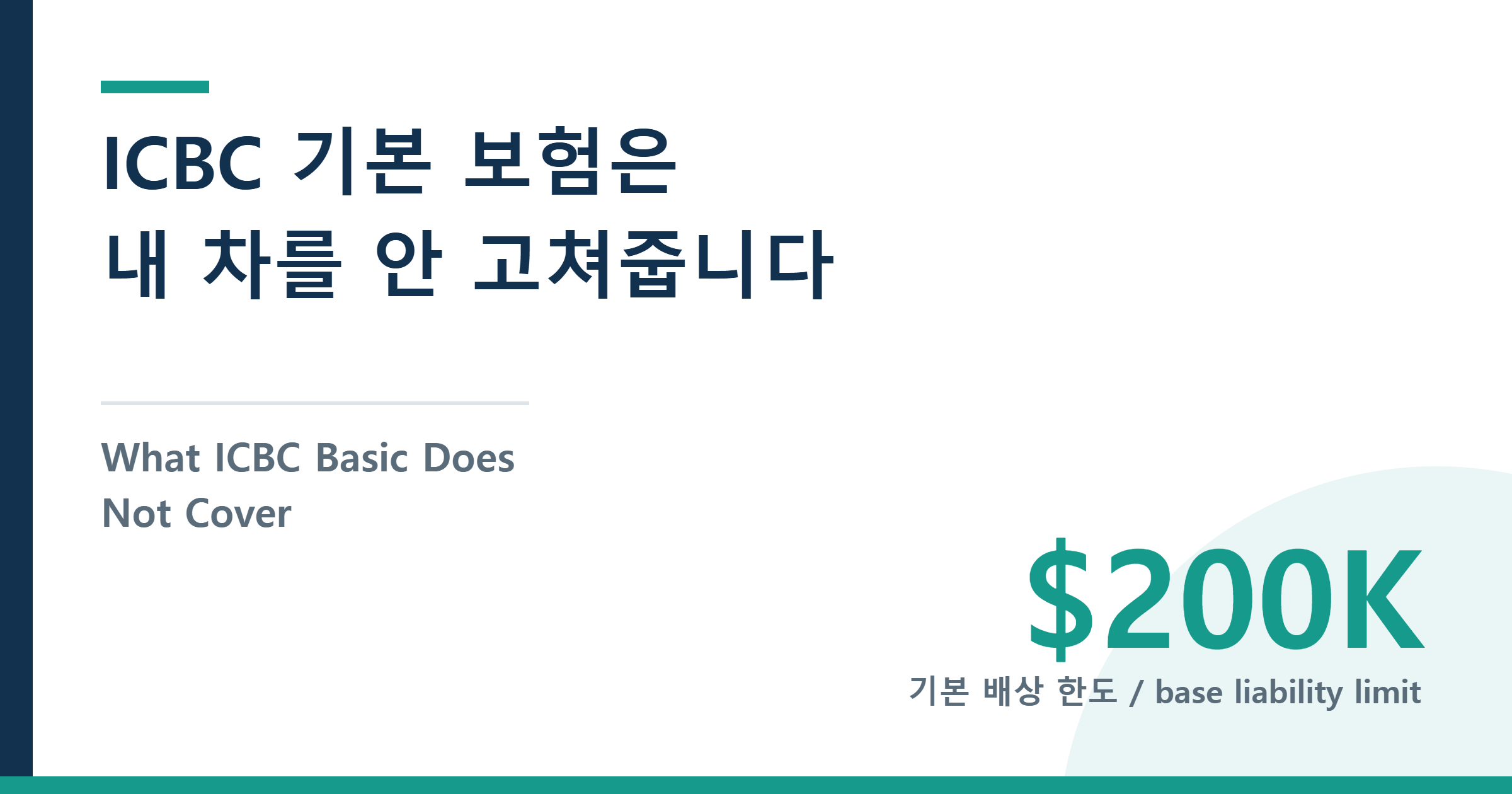
| Third Party Liability | $200,000 base (injury and property) |
| Enhanced Accident Benefits | Treatment, rehabilitation and income loss, regardless of fault |
| Underinsured Motorist Protection | When the other driver is underinsured |
| Hit and Run | Under defined conditions |
Not included — this is the important part
- Damage to your own vehicle (collision, rollover)
- Theft, fire, vandalism, weather, animal strikes
- Windshield damage
- Liability above $200,000
- Rental car while yours is repaired
The first one causes the most confusion. Basic pays for harm you cause to others; it is not a policy that repairs your car. Hit a pole on your own and Basic pays nothing.
Four Add-Ons Worth Considering
1. Extended Third Party Liability
Raises the $200,000 base to $1,000,000–$5,000,000.
$200,000 sounds like a lot until a multi-vehicle collision or an expensive vehicle is involved. Anything above your limit comes out of your personal assets.
This is the best value in the entire lineup. Multiplying the limit typically costs tens of dollars a year. I treat it as mandatory rather than optional.
2. Collision
Covers damage to your own vehicle in a collision, regardless of fault.
- Consider skipping it if the vehicle is low value (say under $3,000)
- Leased or financed vehicles usually require it contractually
3. Comprehensive
Covers non-collision damage — theft, fire, vandalism, hail, falling trees, animal strikes.
In BC, wildlife collisions and winter storm damage are real risks. Worth having if you drive outside the metro area regularly.
4. Windshield / Glass
Dedicated glass coverage. BC highways throw a lot of gravel, and windshield replacement runs $400–$1,000. Worth considering for high-mileage drivers.
Choosing a Deductible

A higher deductible lowers your premium but increases what you pay after a claim.
The test is simple: could you produce that amount in cash today? If not, keep the deductible low and accept the higher premium.
$500–$1,000 is the common range. With a solid emergency fund, going higher to cut the premium is reasonable.
ICBC or a Private Insurer?
| ICBC | Private insurer | |
|---|---|---|
| Basic | Mandatory, monopoly | Not available |
| Optional | Available | Available, often cheaper |
| Claims | Single ICBC channel | Handled by the insurer |
| Convenience | One place for everything | Two parties after a crash |
On price, private insurers frequently win. The trade-off is that after a crash, Basic goes through ICBC and Optional through your private insurer — two channels instead of one.
Practical approach: get the ICBC quote from an Autoplan broker, then compare two or three private quotes. Some brokers handle both. If the gap is small, take the convenience; if it is $200 a year or more, the private option deserves a look.
Recommended Setups
| Situation | Suggested coverage |
|---|---|
| Newcomer, used car under $5,000 | Basic + Extended Liability $1M |
| Typical household, vehicle $15,000+ | Basic + Extended $2M + Collision + Comprehensive |
| Leased or financed | Check the contract — Collision and Comprehensive usually required |
| Long commute or rural driving | The above plus stronger Comprehensive and Glass |
| Second car, low value | Basic + Extended Liability only |
Extended Third Party Liability belongs in every one of these. No other option reduces this much risk for this little money.
Frequently Asked Questions
Q. Why are newcomer premiums so high? No BC driving history. Driving experience from your home country can sometimes be credited, so request a claims-free/no-accident letter in English from your previous insurer and submit it. Prepare it alongside your licence exchange.
Q. Can I carry Basic only? Legally yes. But damage to your own car is not covered at all, and a $200,000 liability limit can fall short in a serious crash.
Q. Does a crash raise my premium? If you are found at fault, yes. At-fault history still affects rating under Enhanced Care.
Q. Do I need insurance while the car sits unused? For long periods you can cancel and return the plates. But theft and fire risk remain, so ask about keeping Comprehensive only.
Q. I rent cars often — do I need extra coverage? Add a rental extension to your own policy, or use your credit card’s rental coverage. The counter product is usually the expensive option.
Summary
The key fact about BC auto insurance is that Basic does not repair your car. It is built around harm to others and care benefits; your own vehicle damage lives in the Optional layer.
Priority order: ① Extended Third Party Liability (effectively essential) → ② Collision and Comprehensive if the vehicle has value → ③ Glass depending on how you drive.
And remember that Optional does not have to come from ICBC. Two or three comparison quotes can change your annual cost by hundreds of dollars.
The next article covers how to actually bring that premium down.
Related Reading
- 5 Ways to Lower Your BC Car Insurance Premium — From Safe Driving to Windshield Repairs
- How to Exchange Your Korean Driver’s Licence for a BC Licence — Documents, Process & Insurance Discounts
- 9 Things You Must Do After an ICBC Crash — Tips from a Claims Interpreter
- BC Tenant Insurance Guide — Do You Need It, How Much, and Where (Newcomer Edition)
- Winter tires in B.C.: which routes require them