
BC auto insurance hits newcomers hardest, because without local driving history you start at a high base rate.
The good news is that more of it is adjustable than people assume. This guide covers the methods that actually work, ordered by impact.
📅 Current as of August 2026. Discount conditions change — verify before your renewal.
First — Basic Rates Are Currently Frozen
ICBC basic rates have not increased in seven consecutive years, and the freeze now runs through 2027. The 2021 shift to Enhanced Care cut average premiums by about $496 (roughly 28%), and five rebates totalling $640 have followed.
So there is little to gain from attacking the basic rate — it is already compressed. The real savings sit in Optional coverage.
Methods, Ranked by Impact

1. Compare Optional Coverage With Private Insurers (biggest effect)
Basic is an ICBC monopoly, but Optional is competitive. BCAA, Intact, Wawanesa, Square One and others all sell it in BC.
For identical coverage, differences of $200–$500 a year are common. Many newcomers never make this comparison because they assume “car insurance in BC = ICBC.”
How: get the ICBC quote through an Autoplan broker, then collect two or three private quotes. Several offer online quoting. Thirty minutes of work.
2. Low-Mileage Discount
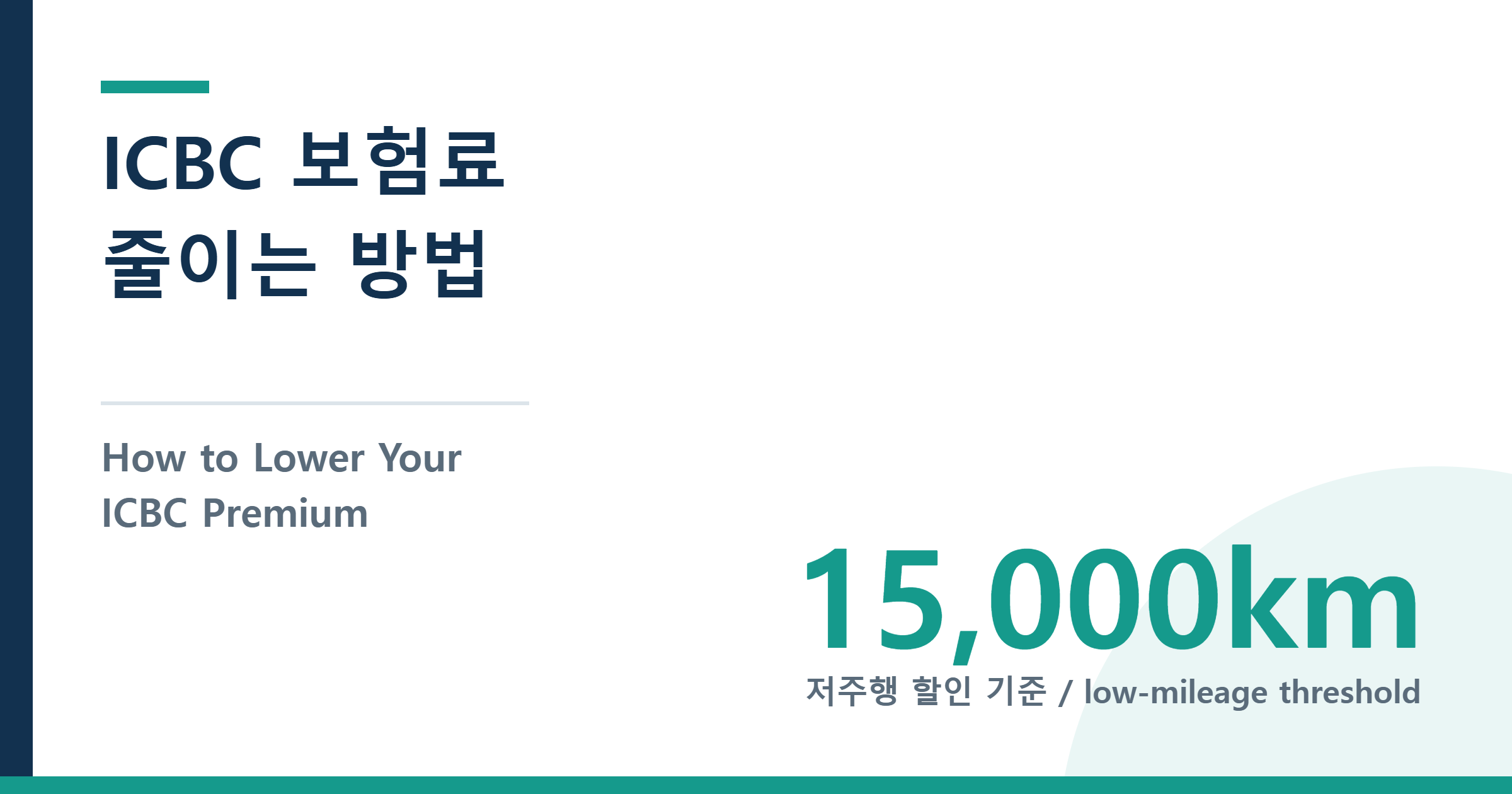
Driving under 15,000 km a year qualifies you for 10–15% off select optional coverages.
If you work from home or combine driving with transit, you may already qualify. It is not applied automatically — ask for it.
Mileage is confirmed by odometer reading at renewal. Do not under-report; it creates problems at claim time.
3. Raise Your Deductible
Moving from $500 to $1,000 lowers the premium.
The test is whether you could pay that amount in cash today. With an emergency fund, raising it is sensible. Without one, leave it alone.
4. Bundling
Combining auto with home or tenant insurance at the same private insurer earns a discount. Pairing your Optional coverage with a tenant policy is a realistic combination.
Multi-vehicle discounts exist too — if your household has two or more cars, consolidate them.
5. Payment Method
Paying annually beats monthly, which carries a financing charge. If the lump sum is difficult that is understandable, but annual is cheaper where possible.

Newcomer-Specific Savings
This matters more than anything else on the list.
Get credit for your driving history from home. BC rating leans heavily on years of experience, and starting at zero is expensive.
- Request a claims-free / no-accident letter in English from your former insurer
- It is far easier to arrange before you leave
- Submit it to your broker for assessment
- Recognition varies by insurer, so ask several
A lot of people simply do not know to do this. Whether your history is credited can nearly double or halve your first-year premium. Prepare it while you are handling your licence exchange.
What Not to Do
Things marketed as savings that usually cost more:
- Dropping coverage you need. Removing Extended Third Party Liability saves tens of dollars against a six-figure exposure
- Dropping Collision on a car that still has value. One crash erases years of savings
- Under-reporting mileage. It surfaces at claim time
- Choosing the cheapest quote without comparing terms. Different coverage is not a price comparison
Renewal Checklist
Do not let renewal roll over automatically. Check these once a year:
- Was your mileage under 15,000 km?
- Has the vehicle depreciated enough to revisit Collision?
- Have you compared private quotes recently?
- Does your deductible still match your finances?
- Is there another policy to bundle (tenant insurance)?
- Has the driver list changed?
Frequently Asked Questions
Q. How much does a crash raise my premium? It depends on fault and history. For a minor incident, paying out of pocket can work out cheaper — talk to your broker before filing.
Q. Is there a penalty for switching insurers? Optional coverage moves freely, though mid-term cancellation fees can apply. Switching at renewal avoids that.
Q. Can I suspend coverage over the winter? Yes — returning the plates prorates your premium. But theft and fire exposure remains, so ask about keeping Comprehensive only.
Q. Does adding my spouse increase the cost? Adding an inexperienced driver can. Conversely, naming an experienced spouse as principal driver can lower it. Run quotes both ways.
Q. Is there a winter tire discount? Not typically as a direct premium discount. But winter tires are legally required on some routes, and avoiding a claim is what protects your rate.
Summary
The most reliable way to cut BC auto insurance cost is to shop your Optional coverage. The basic rate is frozen and offers little room, but Optional is a competitive market where comparison alone moves hundreds of dollars.
After that come the low-mileage discount (10–15% under 15,000 km) and deductible adjustment.
If you are a newcomer, get that claims-free letter from your previous insurer. It is the single largest factor in your early premiums.
And do not cut coverage you actually need to get there — particularly liability limits, where a few dollars a month stands between you and a six-figure exposure.
Related Reading
- Why ICBC Basic Insurance Isn’t Enough — How to Set Up Your Coverage
- How to Exchange Your Korean Driver’s Licence for a BC Licence — Documents, Process & Insurance Discounts
- 9 Things You Must Do After an ICBC Crash — Tips from a Claims Interpreter
- BC Tenant Insurance Guide — Do You Need It, How Much, and Where (Newcomer Edition)
- Winter tires in B.C.: which routes require them