
The first article covered the BC grant of $1,200 and the second covered the federal CESG of $7,200. Together that is $8,400 of government money per child, and more if you qualify for the Canada Learning Bond.
Choose the wrong account and two things happen at once. You may not be able to receive the grant at all, or you hand back more than the grant in fees. This article puts numbers on both.
The order of questions, and why the fee is second
Most people start with which provider is cheapest. For an RESP the order is different.

- Does this provider offer the BCTESG? If not, $1,200 is simply gone
- What is the all-in annual cost — the MER plus any account fee
- What can you invest in? Only relevant once the first two are settled
The reason for that order is simple. The $1,200 is money that is certain today; a fee saving is realised slowly across eighteen years. Chasing 0.2% and losing $1,200 does not add up.
Grant support: the bank’s name is not the answer
Worth repeating from the first article: judge by the legal entity that holds the account, not the brand on the sign.

| Channel | BCTESG |
|---|---|
| BMO branch (BMO Investments) | Yes |
| BMO InvestorLine | No |
| Scotiabank branch | Yes |
| Scotia iTRADE | No |
| CIBC branch (CIBC Securities) | Yes |
| CIBC Investor’s Edge | Unconfirmed |
| Questrade | No — stated on their own site |
| RBC (branch and RBC Direct Investing) | Yes |
| TD (branch and TD Direct Investing) | Yes |
| Wealthsimple | Yes |
| Qtrade | Yes |
The cheaper online arms are disproportionately the ones that do not offer it. BMO InvestorLine, Scotia iTRADE and Questrade are all low-cost channels, and none of them handle the BCTESG.
The authoritative source is the federal List of RESP Promoters, which marks a British Columbia BCTESG column Offered or N/A for each legal entity. The Province of BC points at that same list; 56 institutions currently participate.
The fee, and why it can exceed the grant
Here is the core of this article, with actual numbers.
Assume: start at age 6, contribute $5,000 a year for nine years (a total of $45,000), collect $7,200 in CESG and $1,200 in BCTESG, a 6% gross return, and withdraw at 18. That puts $53,400 of principal and grant into the account.

| Account type | All-in annual cost | Balance at 18 | Lost vs the cheapest |
|---|---|---|---|
| Low-cost index funds (TD e-Series and similar) | 0.30% | $85,033 | — |
| Self-directed mixed portfolio | 0.50% | $83,664 | −$1,369 |
| Robo-advisor | 1.00% | $80,336 | −$4,697 |
| Bank branch mutual funds | 2.00% | $74,060 | −$10,973 |
| Bank branch mutual funds, higher end | 2.50% | $71,104 | −$13,929 |
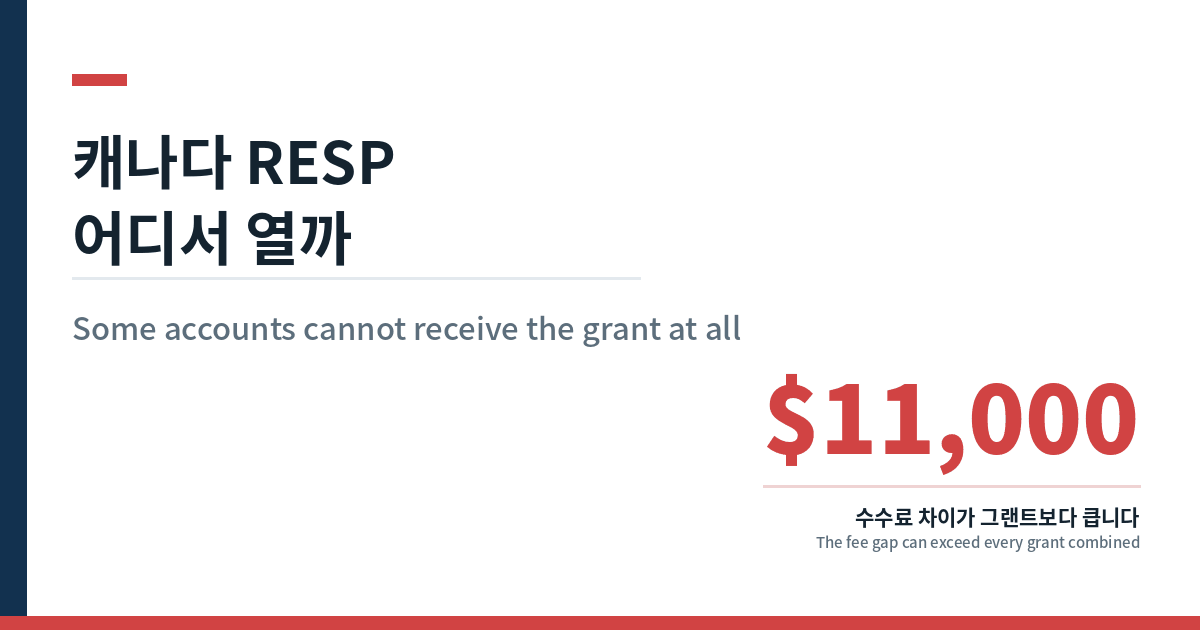
The gap between 0.30% and 2.00% is roughly $11,000.
Sit with that for a moment. The government contributed $8,400, and the fee difference is larger than all of it. Everything the first two articles were about — the deadline, the contribution schedule — can be undone by one choice of account.
The five options and what they actually cost
| Type | All-in annual cost | BCTESG | Effort | Suits |
|---|---|---|---|---|
| Bank branch mutual funds | 1.5–2.5% | Mostly yes | None | You want to be walked through it in person |
| TD e-Series | 0.30–0.44% | Yes | Once or twice a year | You want minimum cost and can handle simple screens |
| Self-directed ETFs | 0.05–0.50% | Varies | Quarterly | You have invested before |
| Robo-advisor | 0.7–1.0% | Wealthsimple yes | None | Hands-off, but cheaper than branch funds |
| Group scholarship plan | 1.65–1.99% plus structural limits | Yes | None | See the separate section below |
Opening it at a bank branch
The most accessible route, and BCTESG support is close to certain. As a first account for a newly arrived family it is a reasonable choice.
The problem is what gets recommended at the counter, which is usually an in-house mutual fund at 1.5% to 2.5%. As the table shows, that gap runs into five figures over eighteen years.
There is a workable compromise. Open the RESP at the branch, then ask specifically for a low-cost index fund or a GIC — nobody will offer it unprompted. Or open at the branch to secure the BCTESG now and move to a cheaper channel later.
One condition on moving, though. Under ESDC policy (Notice #845A) the BCTESG only transfers if the receiving institution also offers it. Transfer to one that does not and the BCTESG is not repaid, but it stays behind in the old plan — meaning you have to keep that account open, and closing it forfeits the $1,200.
Opening it at a discount brokerage
The cheapest option, but grant support is a coin flip. Questrade, BMO InvestorLine and Scotia iTRADE cannot do it. TD Direct Investing, RBC Direct Investing and Qtrade can.
If you already hold an RESP at Questrade, opening a second RESP elsewhere is faster than transferring. The $50,000 lifetime limit follows the child rather than the account, so splitting is harmless.
Also worth knowing: some brokerages do not publish the Annex D form on their website — TD Direct Investing among them. You have to request it, so allow extra time.
Robo-advisors
Wealthsimple supports the BCTESG and documents the eligibility rules in its own help centre. Account opening and the grant application both happen online, with automatic rebalancing. It sits in the middle: hands-off, but cheaper than branch mutual funds.
Watch what the headline fee covers. A robo-advisor’s advertised rate is sometimes the management fee only; the real cost is that plus the MER of the underlying ETFs. The 1.00% in the table above is the combined figure.
Justwealth makes no mention of the BCTESG on its RESP page, its FAQ or its RESP guide, and does not appear on the ESDC promoter list. Third-party blogs say it is supported, but that is unverified — ask them directly if you use it.
Group scholarship plans: choosing one knowingly is different from being sold one
These are often pitched in maternity wards, at baby expos and at community seminars. The major group plan providers are ESDC promoters, so they can file for the CESG and BCTESG on your behalf. Which grants actually get applied for varies by company and plan, so read your contract — and understand the structure before you sign.
Structural points worth knowing
- It is not an individual account. Contributions from many subscribers are pooled and paid out at set times in a set way
- Early exit is expensive. Under the Embark Student Plan summary, cancelling within 60 days returns your contributions in full; after that you receive only the amount left after fees and adjusted for investment risk, you give up the earnings, and the government grants go back to government
- Annual management fees run to 1.99% (a 1.65% weighted average in 2025), high relative to low-cost index options
- Your child’s timing and type of school need to fit the plan’s terms for payouts to run smoothly
What happened in the industry
A class action over group RESP enrolment fees and sales charges was authorised in the Quebec Superior Court (file 500-06-000932-182) on 20 April 2021. The plaintiffs alleged that enrolment fees exceeded $200 per plan and that subscribers who cancelled early lost more than 20% of their contributions to enrolment fees, sales charges or membership fees. These are allegations, not findings of fact by the court.
Children’s Education Funds, Knowledge First Financial and Heritage Education Funds settled for a combined $634,072.93, with court approval steps running through August and September 2025. The three companies denied the allegations and stated they settled only to avoid the cost of a trial. The proceeding continues against CST, Kaleido and Global.
Note that current products are structured differently. The Embark Student Plan has removed the up-front sales charge — its own wording is that there is no initial sales charge to enrol in the plan. Do not treat an older contract and a currently sold product as the same thing.
If you are already in a group plan
Run the numbers before cancelling.
On an older front-loaded contract the enrolment fee has already come out of your early contributions. Cancel now and that money does not come back, while you also give up the earnings and the grants. It is a sunk cost; the comparison that matters is the cost of the remaining years.
- Total enrolment fees and sales charges paid so far (from the contract or annual statement)
- What you would actually receive if you cancelled today
- Total government grants received into the plan — these are returned on cancellation
- What the remaining years will cost if you stay
If item 3 is large, staying is often the better outcome. If you cannot tell, show the contract to an independent advisor rather than the company that sold it. Asking the salesperson about cancelling is structurally the wrong conversation.
Sensible combinations for immigrant families
Newly arrived, not comfortable doing this in English. Open the RESP at your existing bank branch, secure the BCTESG first, and ask for a low-cost index fund. If the grant window is tight, the investment choice can be changed later.
Comfortable online. Wealthsimple or TD Direct Investing. Both support the BCTESG; Wealthsimple finishes the whole thing online, TD Direct Investing goes cheaper via e-Series.
Already using Questrade. Leave it and open a second RESP purely for the BCTESG. Transfers take weeks.
Checklist for opening the account
- Child’s SIN in hand — same-day issuance if you go in person
- Confirm the institution offers the BCTESG on the ESDC list
- For a brokerage account, check the legal entity name
- Annex D form, version (2023-05) E — older versions get rejected
- Proof of BC residency: BC licence, BC ID, or a utility bill under three months old
- Choose the investments after opening — an unallocated account sits in cash
- Set the transfer: $209 or $417 a month (see the second article)
That second-to-last item is missed more often than you would expect. Open the account without selecting investments and the money sits in cash earning nothing for years. Go back in a week later and confirm. While you are reviewing accounts, it is worth checking your bank fees and where you park cash you have not contributed yet.
Next in this series
That covers building it up. The final article goes the other way: what happens if you move back to Korea, and what happens if your child does not go on to post-secondary. An RESP treats contributions, grants and growth under three different sets of rules, and withdrawing without knowing that gets expensive.