
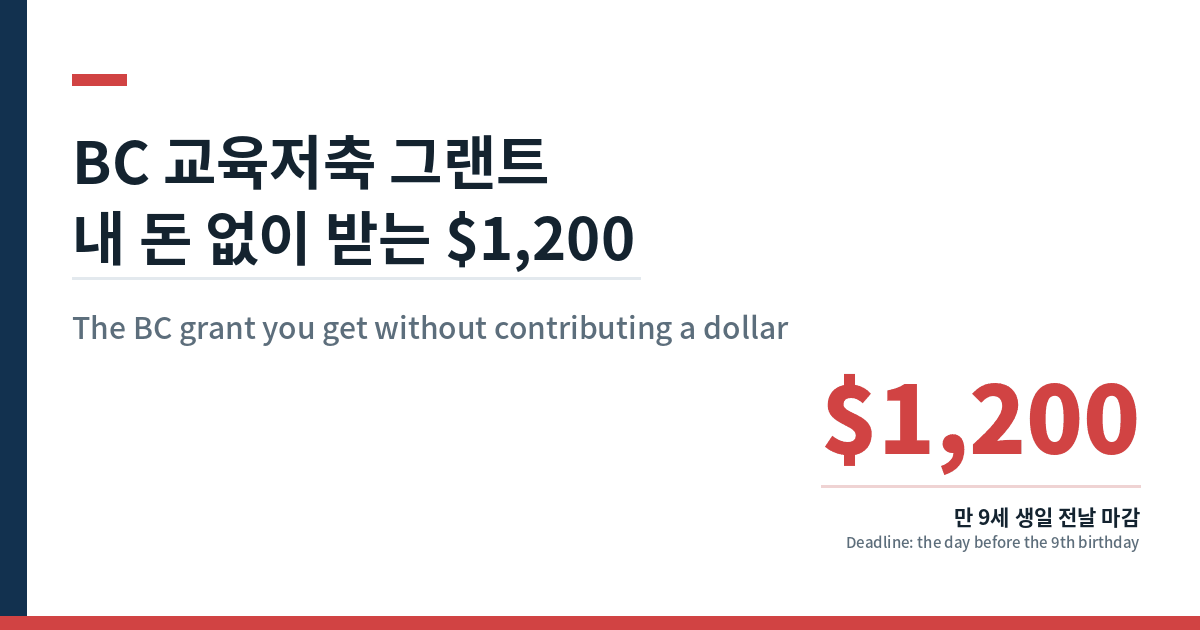
British Columbia will put $1,200 into your child’s education savings, and you do not have to contribute a single dollar to get it. Yet a lot of immigrant families never claim it.
There are usually three reasons. They had the deadline wrong. They assumed they needed savings of their own first and put it off. Or they happened to open their RESP at a provider that does not handle this grant at all.
All three are unrecoverable once the window closes. Here is each one.
The window: age 6 to the day before 9
The Province of BC states it plainly: the application window runs between the child’s 6th birthday and the day before they turn 9.
The moment your child turns 9, eligibility ends. There is no late application and no appeal.

If your child is already 8, count the days. Processing takes weeks, but what matters is the date your application is received. Families get caught while gathering documents, not while waiting for payment.
Some sources online have this wrong
While researching this, I found a well-known Canadian personal finance blog describing the window as running to the last day that your child is nine years old.
That is a full year later than the official wording. Believe it and you will think you have time you do not have.
English-language blogs are the default reference for a lot of us, and quietly wrong details do circulate. For amounts and deadlines, check the provincial and federal pages directly.
You do not contribute anything
The BC government flyer says it outright: No need to add any of your own money!
The BCTESG is not a matching grant. If an RESP exists and your child qualifies, $1,200 arrives even if your own contributions are $0.
This is the part people misread. The federal CESG is a match — 20% of what you put in — so if you blend the two in your head, you conclude you should wait until you have savings to spare. Then the 9th birthday passes. An empty account still collects this one.
Three grants, and only one needs your money
An RESP can receive three different government programs. Telling them apart is the whole starting point.

They do not reduce one another. If you qualify for all three, you receive all three — up to $10,400 per child in government money.
This article covers the BCTESG. The contribution schedule for collecting the full CESG is the next article in this series.
Who qualifies
- The child is 6 or older and has not yet turned 9
- The parent or guardian and the child are both BC residents at the time you apply — there is no minimum length of residency
- An RESP is open in the child’s name
- The child has a Social Insurance Number
Accepted proof of BC residency includes a valid BC driver’s licence, a BC ID card, or a utility bill dated within the last three months. Newly arrived and no licence yet? A BC Services Card or a utility bill will do.
The five steps

You do not apply to the government yourself. The BCTESG is provincial money, but Employment and Social Development Canada administers the payments, and your financial institution files on your behalf. If your provider is not connected to ESDC for this grant, there is no way to apply at all.
The form is Annex D — check the version
The exact form is ESDC SDE 0093-D, Annex D — Application: British Columbia Training and Education Savings Grant, an annex to the federal CESG and CLB application (SDE 0093).
The version in force is (2023-05) E, mandatory since 1 May 2024. Several bank and brokerage sites still host the 2016 or 2017 edition, so a form pulled off a search result can come back rejected. Ask your provider for it, or take it from the Service Canada page.
Which providers — the bank’s name is not the answer
This is the most practical part of the article. Not every institution offers the BCTESG, and within a single bank the answer can differ by which arm holds the account.
| Provider | BCTESG |
|---|---|
| Questrade | No — stated on their own site |
| BMO branch (BMO Investments) | Yes |
| BMO InvestorLine | No |
| Scotiabank branch | Yes |
| Scotia iTRADE | No |
| CIBC branch (CIBC Securities) | Yes |
| CIBC Investor’s Edge | Unconfirmed |
| RBC (branch and RBC Direct Investing) | Yes |
| TD (branch and TD Direct Investing) | Yes |
| Wealthsimple | Yes |
| Qtrade | Yes |
Notice the pattern: the cheaper online arms are the ones that tend not to offer it. A BMO branch mutual-fund RESP qualifies; a BMO InvestorLine RESP does not. Same with Scotiabank and Scotia iTRADE.
The authoritative check is the federal List of RESP Promoters published by ESDC, which has a British Columbia BCTESG column marked Offered or N/A for each legal entity. The Province of BC points to that same list, and 56 institutions currently participate.
While you are choosing where to open it, it is worth checking how to get your Canadian bank fees to zero, and parking any lump sum you are not contributing yet in a high-interest savings account.
If your RESP is at Questrade
Questrade does not currently facilitate BCTESG.
That is from Questrade’s own page. It is a popular choice for its low fees, but this grant is not available there. Two ways out:
- Open a second RESP elsewhere. A child can have more than one. The $50,000 lifetime contribution limit follows the child, not the account, so splitting causes no problem. Claim the BCTESG in the new account and leave the rest where it is.
- Transfer the account. Apply for the grant at the new provider afterward. Transfer fees may apply and it takes weeks.
If your child is past their 8th birthday, take the first option. Transfers are slow.
If your child has no SIN yet
You cannot open an RESP without one — more precisely, you cannot designate your child as a beneficiary until the SIN has been given to the provider. Applying is free, and a parent or legal guardian applies on a minor’s behalf.
| How you apply | How long |
|---|---|
| Online | About 5 business days |
| In person at Service Canada | Same day, if your documents are in order |
| By mail | About 20 business days |
Documents depend on status: a PR card or COPR for permanent residents, the parent’s work or study permit for temporary residents, a birth certificate for children born in Canada, plus supporting ID. If you are also sorting out CCB and CRA access, see this guide to SIN, CCB and CRA after PR.
If the 9th birthday is close, go in person. Same-day issuance can buy you weeks.
How long payment takes
Neither the Province nor ESDC publishes a processing time. Community reports put it around 6 to 8 weeks, generally slower than the federal CESG.
What matters is that eligibility is judged on the date your application is received. Apply at 8 years and 11 months and payment can land after the birthday without any problem. The risk is a rejected form you have to resubmit while the window closes, so leave margin.
Questions people ask
Two children — do we get it twice? Yes. It is $1,200 per child, counted separately even inside a family RESP. Each child has their own 6-to-9 window, so watch the second birthday too.
We just moved to BC. Eligibility looks at your residency when you apply. There is no waiting period. Just make sure you have acceptable proof of address.
My child is already 9. The BCTESG is gone, but the federal CESG runs to age 17 and unused room carries forward. That is the next article.
What if our child does not go to post-secondary? The grant returns to government. Your own contributions always come back tax-free — grants are the part reserved for education.
We may move back to Korea. Claim it anyway. The BC residency test applies only at the time of application, and $1,200 already paid into the plan stays in the plan even after you leave BC. New contributions and new grants stop if the child becomes a non-resident, but what is already there is not forfeited. Account-by-account treatment on leaving Canada is covered in the TFSA mistakes and non-residency guide.
Three things worth doing today
- Work out how many days remain until your child’s 9th birthday
- Check whether your provider offers the BCTESG — especially if it is an online brokerage account
- If your child has no SIN, book a Service Canada visit
$1,200 is roughly half a month’s rent in this province, and it costs you nothing to receive. You only need to act once inside a three-year window.
Next in this series: the contribution schedule that collects the full $7,200 CESG, how families who started late catch up through carry-forward, and the condition that quietly reduces the grant to zero once a child turns 16.