
📌 Updated 14 September 2026 — the 2027 cap is confirmed at 2.2% (announced August 27, effective January 1, 2027). The September report also extends the run of declines to 26 straight months. Details in the 2027 cap section below.
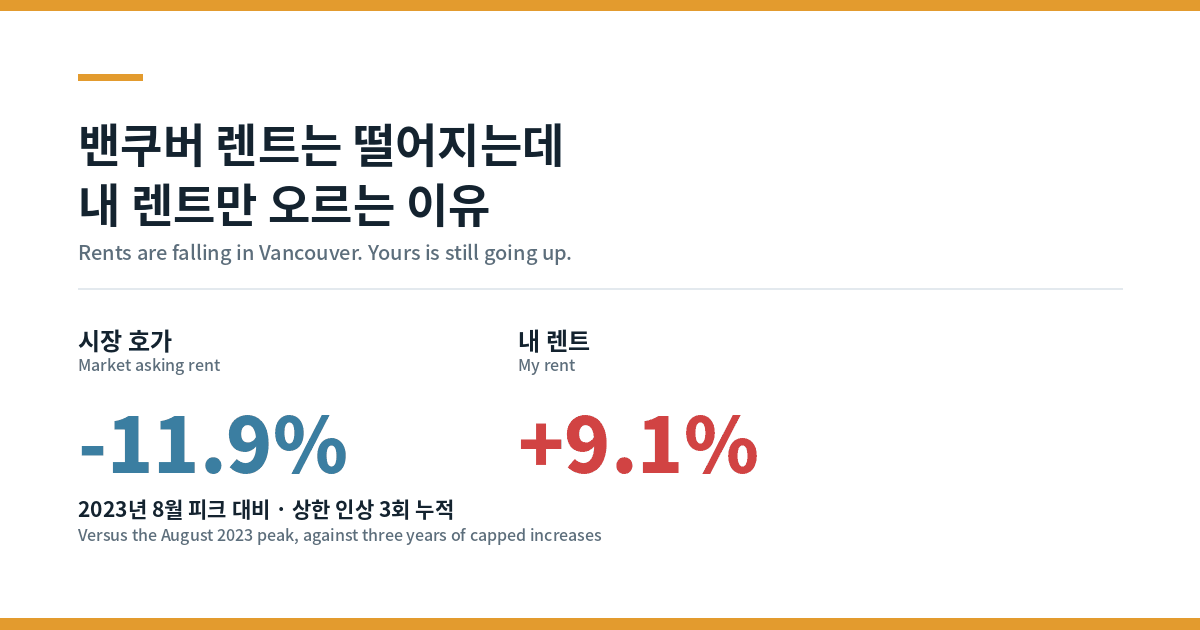
Asking rents in Vancouver have fallen for 26 months straight. That is from the B.C. government’s August 6 rental report. Measured against the August 2023 peak, province-wide asking rents are 11.9% lower, and purpose-built rental apartments in Vancouver are 20% lower.
And yet plenty of tenants received a rent increase notice that same month.
That is not a contradiction. B.C. has two separate rental markets. This piece explains how they work, how to tell which one your tenancy sits in, and what you can actually do about it.
The August numbers
| Measure | Figure |
|---|---|
| Consecutive months of decline | 25 |
| Latest asking rents, year over year | -4.5% |
| Purpose-built rental apartments | -4.1% |
| Versus the August 2023 peak | -11.9% |
| Vancouver purpose-built, versus peak | -20% |
Five B.C. cities landed in the national top 15 for the largest declines.
| City | Year over year |
|---|---|
| Abbotsford | -12.4% |
| Langley | -7.6% |
| Coquitlam | -7.3% |
| New Westminster | -6.6% |
| Richmond | -6.1% |
It is still expensive, though. B.C. averages $2,357 for apartments and condos, second only to Nova Scotia at $2,377. A three-bedroom in Vancouver averages $3,996.
Two markets: asking rent and contract rent
Every figure above is an asking rent — the price on units listed right now. What a sitting tenant pays follows entirely different rules.
| New tenancy | Sitting tenancy | |
|---|---|---|
| How the price is set | The market sets it | Original rent plus the annual cap |
| 2026 ceiling on increases | None | 2.3% |
| When the market falls | It falls too | It does not |
The two markets are not connected. A vacant unit in your building can list $300 below last year while your own rent still goes up 2.3%.
Rent control protects you in a rising market and traps you in a falling one

Rent control did its job on the way up. Through 2021 to 2023, while the market surged, sitting tenants saw increases of 0% to 2%. Staying put was the right move.
The direction has reversed. The market is falling while your rent keeps climbing by the cap. The two lines separate.
The cap, year by year

| Year | Cap |
|---|---|
| 2020 | 2.6% |
| 2021 | 0% |
| 2022 | 1.5% |
| 2023 | 2.0% |
| 2024 | 3.5% |
| 2025 | 3.0% |
| 2026 | 2.3% |
| 2027 | 2.2% |
Move in at the August 2023 peak, take the full increase in 2024, 2025 and 2026, and you are up 9.1% cumulatively. Over the same stretch the market fell 11.9%, and 20% for Vancouver purpose-built. That is a gap of more than 20 percentage points.
What that looks like in dollars
Assumptions — moved in August 2023, full cap applied each year, current market estimated by applying the published declines.
| Starting rent | Your rent now | Market (-11.9%) | Monthly gap | Annual gap |
|---|---|---|---|---|
| $1,800 | $1,963 | $1,586 | $377 | $4,527 |
| $2,000 | $2,181 | $1,762 | $419 | $5,030 |
| $2,200 | $2,399 | $1,938 | $461 | $5,533 |
| $2,500 | $2,726 | $2,202 | $524 | $6,287 |
Against Vancouver purpose-built (-20%) the gap widens further: starting at $2,000 puts you $581 a month, or $6,974 a year, above market.
⚠️ These are illustrations, not your numbers. Real market rent varies unit by unit. Check yours using the method below.
How to tell whether you are above market
Averages will not answer this. You have to compare like with like.
- Start with your own building. It is the cleanest comparison there is. Many building managers will tell you outright what a vacant unit is listing for.
- Gather at least five listings in the same neighbourhood, same bedroom count, similar building age.
- Normalise before you compare. If the items below do not match, the comparison is meaningless.
| Check | Why it matters |
|---|---|
| Parking included | $75 to $200 a month in Vancouver |
| Utilities (heat, hot water, electricity) | Easily $100 a month either way |
| In-suite versus shared laundry | A larger practical difference than people expect |
| Floor, view, renovated or not | Units differ within the same building |
| Purpose-built rental versus an individual condo | The two move on different cycles |
One caution — a listing price is what someone is asking, not what a unit rented for. Signed rents can be lower still.
Where your leverage comes from: B.C. has no vacancy control
This is the part most tenants do not know.
When a tenancy in B.C. ends, the landlord can reset the rent to whatever the market will bear. The annual cap applies only between the same landlord and the same tenant. There is no vacancy control.
On the way up, that rule favoured landlords. A tenant moving out meant the unit could be re-listed higher.
Right now it cuts the other way.
If you are paying above market, your leaving is a loss for your landlord. The replacement tenant pays less, and the vacancy, advertising and screening cost money in between.
That is your basis for a conversation. It stops being a favour you are asking for and becomes an argument with numbers behind it.

If you try to renegotiate
Your landlord is under no obligation to agree. But the structure above means the conversation sometimes lands.
- Raise it before the increase notice goes out. Reversing one afterwards is a nuisance for everyone.
- Argue with evidence, not feelings. A tidy list of current listings in your building and neighbourhood does the work.
- Make the ask concrete. “Freeze it this year and I will sign on for another year” gives the other side something to calculate. “Please do not raise it” does not.
- Put everything in writing. A verbal agreement cannot be proven later. Send a summary email and get a reply.
- A no costs you nothing. Penalising a tenant for asking is unlawful.
If you are weighing a move
Do not look at the monthly saving alone. Net out the one-time costs.
| Item | Rough cost |
|---|---|
| Movers (one bedroom, within Metro Vancouver) | $400 to $900 |
| New deposit (half a month’s rent) | Doubled up if the old one has not been returned yet |
| Wall repairs and cleaning before you go | $0 to $300 (materials only if you do it yourself) |
| Internet install or transfer | $0 to $150 |
| Change in commute time and cost | This one repeats every month |
Break-even = one-time costs ÷ monthly saving. Saving $400 a month against $1,600 in costs pays back in four months. A $80 gap usually is not worth moving for.
All of which assumes you get your deposit back in full. See getting your deposit back, wall repairs before move-out and what a landlord can charge for paint damage.
Got an increase notice? Check it is valid first
An invalid notice does not have to be paid. Four things to verify.
- The form. It must be Form RTB-7, Notice of Rent Increase. A text message or an email is not valid.
- Three full months of notice. To take effect November 1, the notice has to reach you by July 31.
- Twelve months apart. At least twelve months since the last increase, or since the rent was first set.
- The amount. For 2026 it cannot exceed 2.3%. On $2,000 that is $46.
If something is off, write to your landlord first — most of these are honest mistakes. If that goes nowhere, you can apply to the Residential Tenancy Branch for dispute resolution.
If you already paid an overcharge, you may deduct it from a later rent payment — but tell your landlord in writing before you do.
The 2027 cap is confirmed at 2.2%
Announced on August 27, 2026 and effective January 1, 2027. That is 0.1 of a percentage point below the 2.3% ceiling for 2026.
The formula is the 12-month average change in B.C.’s all-items Consumer Price Index, ending in July of the preceding year. This is the seventh consecutive year the province has held the cap at or below inflation. Before 2019, landlords could add two points on top of inflation.
What it comes to — $44 a month on $2,000, $55 on $2,500. The notice rules do not change: still Form RTB-7, three full months ahead, and still twelve months since the last increase.
⚠️ The 2.2% applies to increases that take effect on or after January 1, 2027. A notice whose effective date falls inside 2026 is still governed by this year’s 2.3%. Read the effective date on the notice, not the date it was sent.
Frequently asked questions
Q. The market fell, so can I demand a decrease?
There is no legal right to one. The legislation caps increases; nothing compels a reduction. This is negotiation territory.
Q. Can I just ignore an increase notice?
Not if it is valid. You would be treated as in arrears and could face an eviction notice. Dispute it in writing rather than ignoring it.
Q. Do I have to leave when a fixed term ends?
No. In most cases the tenancy converts automatically to month-to-month. Vacate clauses are enforceable only in limited circumstances.
Q. What if my landlord retaliates for asking?
Retaliation for exercising a legal right is unlawful. Keep records; you can report it to the RTB.
Q. If I move now, do I lose out when the market turns?
Possibly. But the same annual cap applies to your new tenancy too, so restarting at a lower number lowers your baseline for years afterward.
The short version
- The published declines are asking rents. Sitting rents move on their own track.
- Rent control protects you on the way up and traps you on the way down.
- Move in at the 2023 peak and you are up 9.1% while the market fell 11.9% — a gap of more than 20 points.
- B.C. has no vacancy control. If you are above market, your landlord has no reason to want you gone. That is your leverage.
- Judge a move on months to break even, not the monthly saving.
- On any notice check form, three months, twelve months, 2.3% before anything else.