
This is not investment advice. It is a personal account, and any investment decision is yours to make.
Honestly, I am not someone who knows much about investing.
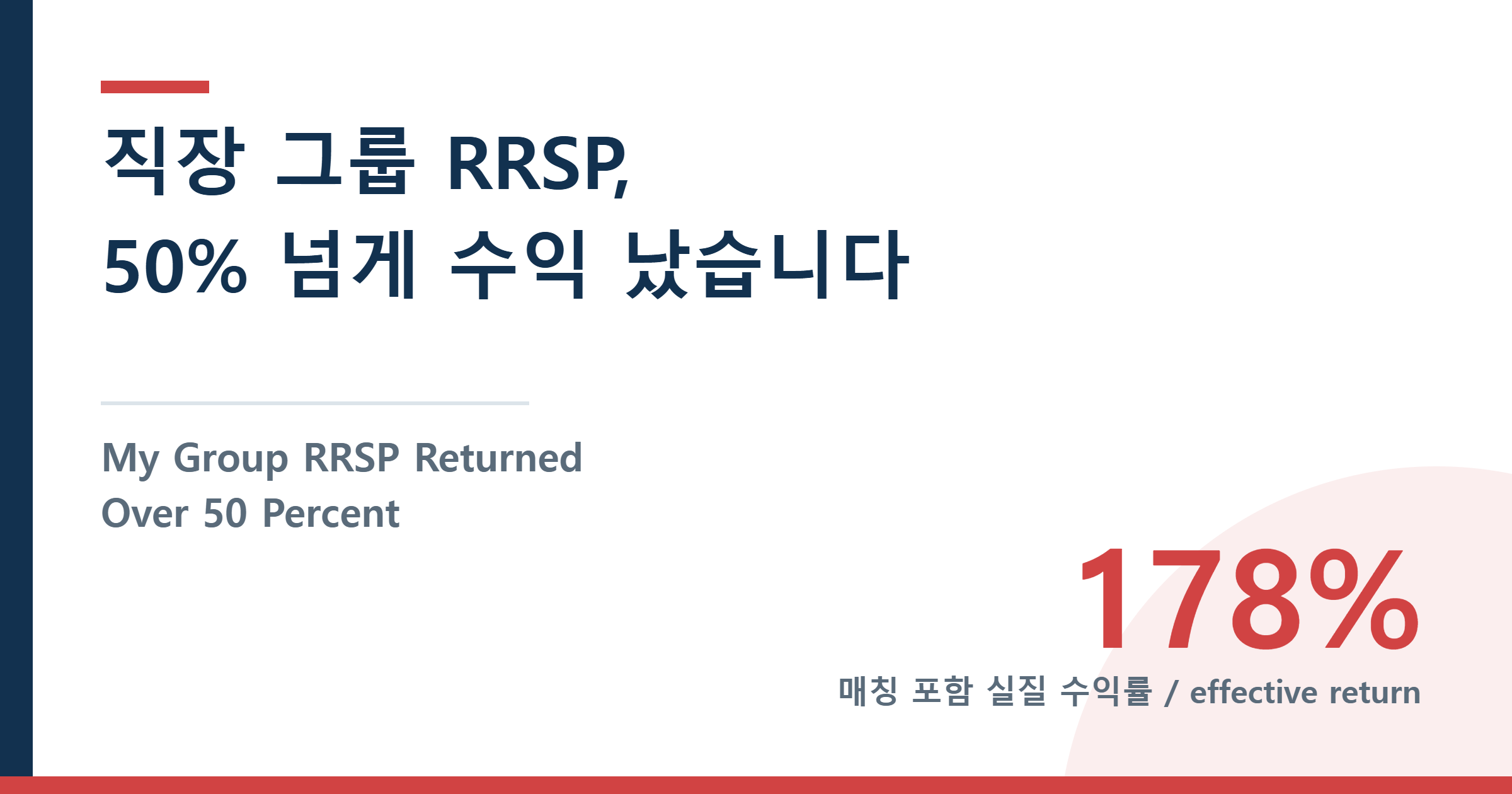
I first learned what an RRSP and a TFSA even were after arriving in Canada, and stocks felt even further out of reach. But through a group RRSP at a previous employer, I ended up more than 50% ahead as of early 2026.
Luck played a part. But the structure that created that luck is available to anyone. That is what this article is about.
What Is a Group RRSP?
With an individual RRSP, you open an account at a bank or brokerage and contribute yourself. A Group RRSP is run by your employer as a workplace benefit.
The mechanics are the same — you contribute pre-tax income and pay tax on withdrawal — but there is one decisive difference.
Your employer puts money in alongside you.
This is called employer matching. It varies by company; mine matched 6% of my salary. I contributed 6%, they added 6%, and 12% of my pay went into the RRSP automatically every two weeks.

That is a 100% return on day one. Put in 100 and 200 gets invested.
💡 If matching is offered, contribute at least up to the maximum match. Not doing so means walking away from free money.
I have seen immigrants skim past the group RRSP line during benefits orientation. This is the one to pay attention to. It gets explained quickly, in English, using unfamiliar terms — I signed without understanding it myself.
Why Matching Matters So Much — In Numbers
“6% matching” is hard to feel in the abstract. Here it is on an $80,000 salary.
| Item | Amount |
|---|---|
| My contribution (6% of salary) | $4,800/year |
| Employer match (6%) | $4,800/year |
| Total invested annually | $9,600 |
| Tax refund from RRSP deduction (at 28.2%) | ~$1,354 |
| Actual cost to me | ~$3,446 |
You pay $3,446 and $9,600 gets invested. That is an effective return of 178% — locked in the moment you enrol, regardless of investing skill or market direction.
To see the cost of skipping it, invert the math. Going five years without matching means giving up $24,000 of employer money, before counting whatever that money would have earned.
Check the match before you negotiate salary. A 6% match is often worth more than a $3,000 raise.
Five Questions to Ask When You Join
Ask HR these when starting a job. These are the ones I did not know to ask.
- “Is there an employer matching program? What is the maximum match percentage?” The single most important question.
- “When does the matching start?” Immediately, or after three, six, or twelve months? Waiting periods are common.
- “Is there a vesting period?” This is when the employer’s money actually becomes yours. Some plans require you to return the match if you leave within two years.
- “What investment options are available, and what are the fees?” The fund menu and the management expense ratio (MER).
- “Is it a Group RRSP, a DPSP, or a pension plan?” They look similar but differ in tax treatment and withdrawal rules.
Vesting deserves attention. I learned the concept late; fortunately mine vested immediately. If your plan has a two-year cliff and you leave at 23 months, you lose the entire employer match.
What Does It Mean That Manulife Manages It?
Employers do not run these plans themselves — they outsource to an insurance or financial firm. In my case it was Manulife, one of Canada’s large financial groups and a major administrator of group retirement plans.
Manulife opens the account, and through their online portal you can check your balance, change investments, and adjust contribution rates. Sun Life, Canada Life, and Desjardins play the same role.
The critical point: your employer chooses who administers the plan, but you choose what to invest in within it. A lot of people never realize this and leave the default in place. I did exactly that for over a year.
Why You Should Not Leave the Default Alone
On enrolment you are usually placed in a default option — typically company stock, or a Target Date Fund that adjusts risk automatically toward your retirement year.
Mine defaulted to 100% company stock. It took me a long time to understand why that was a problem.
Two reasons. First, there is no diversification. Second, and more dangerous — your paycheque comes from the same company. If the business struggles, your job and your retirement savings move together. Two risks pointed in the same direction.
In a cyclical industry like construction, this deserves more thought. With BC construction starts down 18% in 2026, sector risk is not an abstract concern.
Is It Hard to Change Investments?
It is not. This is the part I most regret learning late.
Log into the Manulife portal and you will see the available fund menu. Typically something like this:
| Fund type | Risk | Notes |
|---|---|---|
| Company stock | High | No diversification, overlaps job risk |
| Canadian Equity | Medium–high | Canadian market |
| US Index / Global Equity | Medium–high | Tracks US or global indexes |
| Balanced Fund | Medium | Stock and bond mix |
| Bond Fund | Low–medium | Fixed income |
| Money Market / GIC | Low | Capital preservation |
| Target Date Fund | Auto-adjusting | Rebalances toward a retirement year |
Changing it means entering percentages and hitting save. There are no trading commissions. What does differ is the management expense ratio (MER).
Check this carefully. A fund at 0.5% MER and one at 2.0% produce very different outcomes over thirty years. Group plans often have lower MERs than retail products because they are negotiated collectively, but the spread between funds within the plan still matters. If performance is comparable, take the cheaper one.
What I Actually Did
I started at 100% company stock. Over time I started wondering whether that was right, and the concentration bothered me. So I began shifting portions into a US Index fund.

| Stage | Company stock | US Index fund |
|---|---|---|
| Initial | 100% | 0% |
| After first adjustment | 80% | 20% |
| Midway | 30% | 70% |
| Later | 20% | 80% |
There was no sophisticated strategy behind it. I logged into the portal, looked, shifted the weighting a bit, left it for a few months, repeated.
When I checked the balance in early 2026, I was up more than 50% on contributions.
To be honest about it: most of that came from the structure and the market, not my judgment. Matching doubled the principal, and US indexes performed well over that stretch. The only thing I did was apply the common-sense rule of not putting everything in one place. That one decision made a meaningful difference.
What Happens to a Group RRSP If You Leave?
Once you leave, contributions to that account stop and matching ends. The money does not disappear — the balance stays, and you have options.
| Option | What it means | Verdict |
|---|---|---|
| Leave it at Manulife | Converts to an individual RRSP, no more matching | Fine |
| Transfer in kind to another RRSP | Move to Wealthsimple etc. — no tax, no contribution room impact | Best |
| Withdraw as cash | Taxed as income that year | Avoid |
The common route is converting to an individual RRSP. I am currently preparing a transfer to Wealthsimple. The process is tax-free and does not affect your contribution room.
Two reasons to consider transferring: fees (retail ETFs often carry lower MERs than group funds) and choice (group menus are limited). Note that the departing institution may charge a transfer fee of $50–$150.
⚠️ Never withdraw the cash and re-deposit it. The full withdrawal counts as income that year, and you permanently lose that much contribution room. It must be processed as an account-to-account transfer.
Easy to Miss — the Pension Adjustment
One thing every group RRSP participant needs to know.
Employer contributions are reported as a Pension Adjustment (PA), which reduces your personal RRSP contribution room the following year. If $9,600 went into your group RRSP, your individual RRSP room shrinks accordingly.
Miss this and top up your individual RRSP to the limit, and you have over-contributed — triggering a 1% monthly penalty. When you check your limit in CRA My Account, always look at the PA line too.
Where I Am Now
I feel somewhat inclined to be more conservative lately. Geopolitical uncertainty is high, and US markets feel less predictable than they used to. With the policy rate held at 2.25%, GICs and fixed income do not look unreasonable.
So my current thinking is simple: do not concentrate. Set your risk weighting based on how far you are from retirement, then check in once or twice a year. For a non-expert like me, that is about the right level of involvement.
Frequently Asked Questions
Q. Can I contribute beyond the match limit? Often yes, but anything above the match limit is unmatched. That excess may do better in an individual RRSP or TFSA with lower fees.
Q. Group RRSP or TFSA first? A matched group RRSP always comes first. Fill the match, then the TFSA, then an individual RRSP. Matching is an immediate 100% return, which outranks any tax calculation.
Q. Is holding 100% company stock actually wrong? There is no rule against it. But be aware that your income and retirement savings are tied to the same employer. That discomfort is why I reduced it.
Q. I do not know my portal login. HR can reissue your credentials. Many people are enrolled and have never logged in once. Try today.
Q. What if I move back to my home country? The account stays. As a non-resident, withholding tax applies on withdrawal — talk to an accountant before leaving.
Summary
The point of this article is one thing: the returns came from the structure, not from skill.
Three elements did the work. Employer matching doubled the principal, the RRSP deduction returned tax, and not concentrating reduced risk. None of the three requires expertise.
Two things you can do today: check the match percentage in your benefits documents, and log into your group RRSP portal to see what your money is actually invested in. I did both a year later than I should have.
Again — I am not a financial professional. This is a record of my experience, and your decisions should fit your own circumstances.
Related Reading
- RRSP Contribution Limit 2026: How to Check Your Limit and Maximize Your Tax Refund
- 3 Common TFSA Mistakes: Over-Contribution, Re-Contribution Timing, and What to Do When You Leave Canada
- TFSA Guide for Canadian Immigrants: Eligibility, 2026 Contribution Limit & CRA Check
- Bank of Canada Holds at 2.25% Again — What It Means for Your Mortgage Renewal, HISA, GIC, and Rent
- Best High-Interest Savings Accounts in Canada — HISA Comparison (2026)