
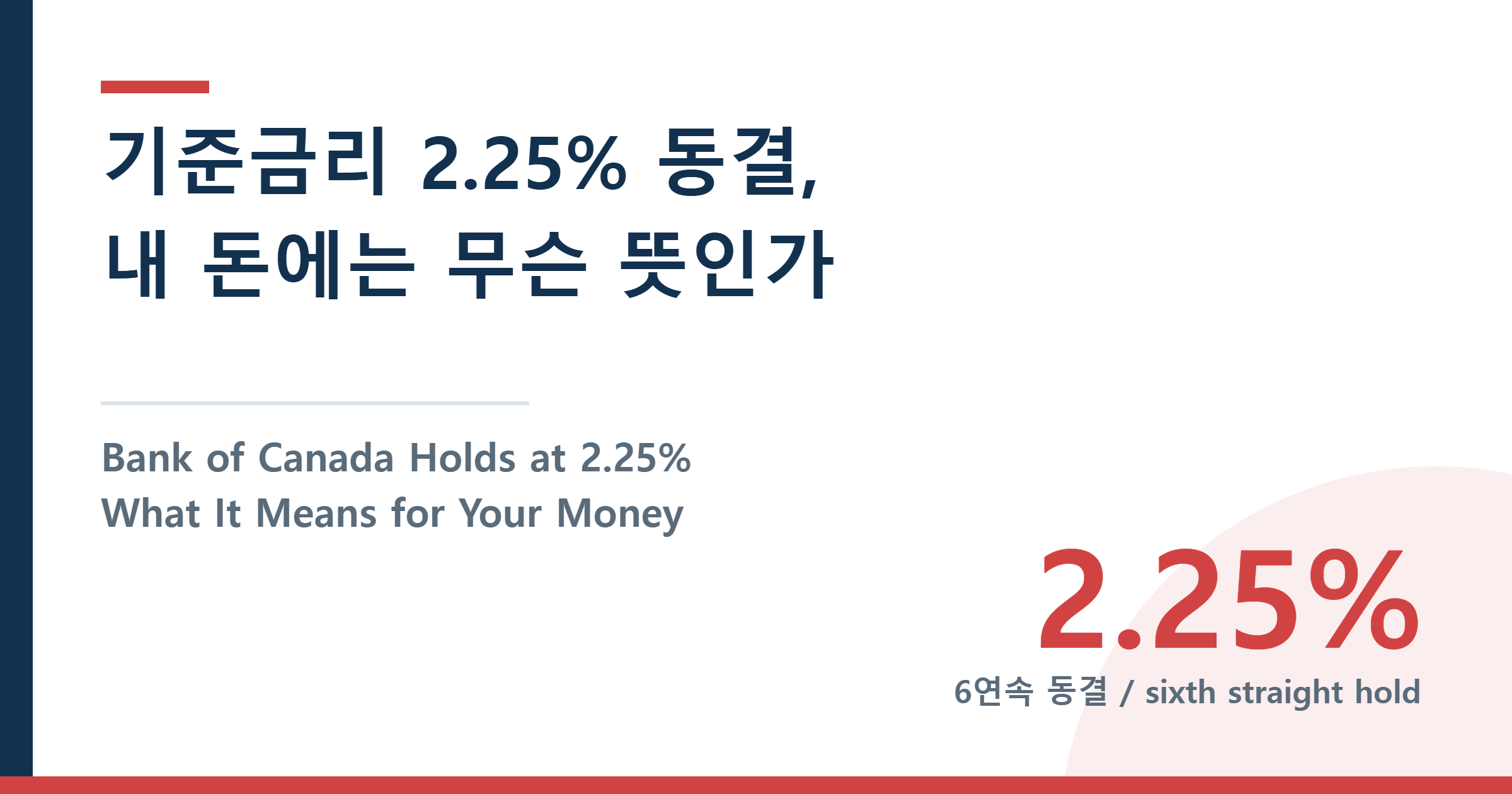
On September 2, the Bank of Canada held its policy rate at 2.25% — the seventh consecutive hold. The news stops there. This article picks up the part that actually matters: so what does it mean for your money?
📅 Updated September 2026. The September 2 decision left the rate at 2.25% for a seventh straight time. The next announcement is October 28. Figures here reflect the September 2 decision.
The statement itself was straightforward. The economy is showing signs of recovery, growth is picking up, and the recent inflation bump is expected to ease. Uncertainty from Middle East tensions and US trade policy means the current rate is judged appropriate.
You do not need to be an economist to read the signal: the Bank has no intention of moving for now. The economy is not weak enough to warrant a cut, and inflation is not hot enough to warrant a hike.
First, the Big Picture
A single number tells you nothing. You need the last six years to see where we actually are.

- 2020–2021: 0.25% in response to the pandemic. A historic low.
- 2022–2023: Ten hikes to fight inflation, peaking at 5.00% in July 2023
- Mid-2024 to 2025: Inflation cooled and the cutting cycle began — nine cuts in total
- Late 2025 to now: Parked at 2.25%, held six times in a row through 2026
One perspective worth holding onto: 2.25% is neither historically low nor high. It is roughly in line with the pre-pandemic decade average. We are closer to “abnormal returning to normal” than to anything unusual.
Which also means the 0.25% era is unlikely to return. If you have been planning around a mortgage you signed in that period, it is time to recalculate.
What Changed on September 2 — The Next Move Might Be Up, Not Down
This hold is not the same animal as the six before it. Those were pauses after a cutting cycle. This one is a hold because inflation has drifted back up and the Bank cannot cut.
| Indicator | Latest | How to read it |
|---|---|---|
| Policy rate | 2.25% (7th straight hold) | Bank Rate 2.50%, deposit rate 2.20% |
| CPI inflation | ~3% | Near 3% for several months, mostly gasoline |
| Core, excluding gasoline | 2.2% | Strip out energy and it is close to the 2% target |
| Q2 GDP | +3.3% | A rebound from a very weak first quarter |
The Bank said plainly that upside risks to its inflation forecast have increased. Two reasons: new US tariffs together with Canadian counter-measures, and Middle East tensions keeping oil prices and refinery margins elevated. Some banks have already started forecasting an October hike.
What this changes in practice. If your plan was “wait a little longer and rates will come down” — choosing variable, or delaying a renewal decision — that assumption is now much weaker. Read the five sections below without it. The next announcement is October 28, 2026, and because the quarterly Monetary Policy Report lands the same day, the direction should get a lot clearer then.
1. If Your Mortgage Is Up for Renewal — A Hold Does Not Prevent the Shock
Start with the most common misconception. “Rates are on hold, so my renewal should be fine” is wrong.
Many people renewing this year signed five-year fixed terms during the ultra-low period of 2020–21. Because of the gap between that rate and today’s, borrowers renewing out of a five-year fixed term face monthly payment increases averaging 15–20% (per Bank of Canada analysis). The policy rate may be frozen, but your contract rate resets well above where it was five years ago.

If you were paying $2,000, expect $2,300–$2,400 after renewal. That is $300–$400 a month, or $3,600–$4,800 a year. In markets like Vancouver, where mortgage balances are larger, the impact is bigger still.
Renewal checklist
- Start four to six months early. Most lenders offer a rate hold four to six months before maturity. Lock in a rate you are comfortable with; if rates fall before maturity, you take the lower one. A hold sets a ceiling, not an obligation.
- Do not sign your lender’s first offer. The rate in your renewal letter is an opening position, not a final price. A mortgage broker will pull quotes from multiple lenders at no cost, and bringing a competing quote often gets your current lender to match.
- Test-drive the increase. Take the difference between your current payment and your projected one, and set up an automatic transfer of that amount to savings starting now. If it is manageable, you are ready. If not, you have time to look at extending your amortization.
- Fixed or variable? The 2026 consensus is that the policy rate stays near this level. Variable wins if rates fall, but that looks unlikely; fixed buys predictability. If your cash flow is tight, take fixed. If you have room and plan to prepay, variable is worth considering.
2. If You Have Cash in a HISA — The Peak Has Passed, but Not the Opportunity
In 2023–2024, HISAs paying 4–5% were common. That is over. The top of the market is now around 3.40%.
But that is still three times what a Big 5 basic account pays (0.01–1.10%). Lower rates are not a reason to give up on savings — if anything, with the gap holding steady, this is a good moment to clean up your accounts.
What a hold means here: these rates are likely to stick around for a while. Waiting for something better while your money sits in a low-rate account just costs you interest in the meantime.
3. If You Are Considering a GIC — A Hold Is a Good Time to Decide
A GIC locks in the rate at purchase for the full term. So you generally wait if rates look likely to rise, and lock in if they look likely to fall.
Right now, neither applies. No spike, no crash is expected. When timing offers little advantage, decide based on your cash flow needs instead.

Approximate ranges as of September 2026:
| Product | Rate range | Money locked |
|---|---|---|
| HISA (top tier) | 2.75–3.40% | No |
| 1-year GIC | 3.30–3.60% | 1 year |
| 5-year GIC | 4.00–4.10% | 5 years |
GIC laddering is worth considering. Instead of putting a lump sum into a single five-year GIC, split it five ways across one-, two-, three-, four- and five-year terms. Something matures every year, giving you liquidity, and you can reinvest at higher rates if they rise.
Caution: do not put your emergency fund in a GIC. Most cannot be broken early without forfeiting interest. Keep at least three to six months of expenses in a HISA.
4. If You Rent — Your Strongest Negotiating Position in Years
There is unexpectedly good news for tenants here.
The 2026 BC annual rent increase cap is 2.3%, down from 3% in 2025. The maximum a landlord can raise rent on an existing tenancy is set by law, and it has fallen to roughly the rate of inflation.
The market is shifting too. BC housing starts dropped about 18% in 2026, from 42,200 to 34,500 units, but previously built inventory is still coming to market — and in some areas vacancy is rising and rent growth has stalled.
What tenants can do now
- Check any increase notice against the 2.3% cap. An increase above it is invalid. Notice must be given at least three months in advance, in writing (form RTB-7).
- Try negotiating at renewal. Losing a good tenant and carrying a vacancy may cost a landlord more than forgoing an increase.
- If you are thinking of moving, recheck the market. Some areas offer better terms than they did a year or two ago.
5. Everything Else — Car Loans, HELOCs, Credit Cards
- Auto loans and leases: broadly track the policy rate, so terms should not shift much. No particular reason to rush or wait.
- HELOCs: variable products tied directly to prime. Prime currently sits around 4.45%, and a continued hold means your carrying cost stays put.
- Credit card interest: essentially unrelated to the policy rate, fixed near 20% annually. Whatever the Bank of Canada does, credit card balances come first. Eliminating 20% debt beats growing a 3% savings account every time.
One-Line Summary by Situation
| Your situation | What to do now |
|---|---|
| Mortgage renewal this year or next | Rate hold 4–6 months out, compare broker quotes, pre-save the difference |
| Idle cash at a Big 5 bank | Move to a HISA (2.75–3.40%) |
| Lump sum you will not need for a year+ | Consider a GIC, ideally laddered |
| Received a rent increase notice | Verify the 2.3% cap and the 3-month written notice |
| Carrying a credit card balance | Pay it down before saving or investing |
| Thinking about buying | Starts down, sales slow — little reason to rush |
Frequently Asked Questions
Q. When is the next rate announcement? October 28, 2026. That date also carries the quarterly Monetary Policy Report. The Bank of Canada announces eight times a year.
Q. Could rates fall further? The consensus is a hold through the rest of 2026. A significant shock from US trade policy or geopolitics could open the door to a cut; a renewed inflation spike could mean a hike.
Q. What is the difference between the policy rate and prime? The policy rate (2.25%) is set by the central bank. Prime (4.45%) is what commercial banks charge their best customers. Variable mortgages and HELOCs track prime.
Q. Should I buy a home right now? That depends entirely on your circumstances. What is factually true is that BC currently has sharply reduced starts and slower sales, which tilts negotiating power toward buyers. I am not a financial professional — talk to a mortgage broker or financial planner before deciding.
Summary
A hold does not mean nothing is happening. It is a forecast that these conditions will persist.
So the move right now is not to wait — it is to get organized. If your renewal is coming, start early. Move your savings somewhere that actually pays. Check any rent increase against the cap. Clear the credit card balance first. When rates stop moving, the difference comes from what you do.
I will update this article after the October 28 announcement.
Related Reading
- Best High-Interest Savings Accounts in Canada — HISA Comparison (2026)
- RRSP Contribution Limit 2026: How to Check Your Limit and Maximize Your Tax Refund
- 3 Common TFSA Mistakes: Over-Contribution, Re-Contribution Timing, and What to Do When You Leave Canada
- I Didn’t Know Much About Group RRSP — But It Returned Over 50%: My Manulife Experience
- Paying Canadian Bank Fees Every Month? Here’s How to Get to $0 — 4 Methods That Actually Work