
With a $0-fee account set up (Part 1) and your savings earning real interest in a HISA (Part 2), the last piece is credit cards.
Choose well in Canada and you can capture $300–$500 in value per year. Choose badly and you pay an annual fee for benefits you never use. This article is not about which card is best — it is about how to calculate which card is best for your spending.
Why Credit Cards Are Genuinely Hard for Newcomers
Arriving in Canada completely resets your credit history. You may have used cards and repaid loans faithfully for twenty years back home, but Equifax and TransUnion have nothing on file. On paper you look like someone who just turned eighteen.
The catch is that your credit score affects far more than card approvals — rental applications, phone plans, car leases, and eventually mortgage approval. So a credit card is a tool for building history before it is a tool for earning rewards. In your early years here, that comes first.
Canadian credit scores run from 300 to 900, and roughly 660+ is good while 725+ is very good. The encouraging part: used responsibly, six months to a year is enough to reach a workable score.
How Newcomers Get Their First Card
Step 1: A Secured Credit Card
The usual starting point with no credit history. You place $500–$1,000 as a deposit and receive a matching limit. The deposit comes back when you close the card.
- Home Trust Secured Visa: no annual fee, generally accessible to newcomers
- Neo Financial Secured: online application, fast approval
- Bank secured products: ask wherever you opened your main account
Step 2: A Bank-Linked Card or Newcomer Program
Opening a main account makes that bank’s basic card easier to get. Most Big 5 banks run newcomer-specific programs that issue cards without a credit history.
- Scotiabank StartRight Program: newcomer-specific, no credit score required
- RBC Newcomer Advantage / BMO NewStart / CIBC Welcome to Canada: similar structures
Limits typically start low, around $500–$2,000. Do not be discouraged — use it well and the limit rises within six to twelve months.
Step 3: After Six to Twelve Months, Upgrade
Once you have history, move to the rewards cards below. This is where the value starts.
Four Habits That Build Your Score Fast
Having a card is not enough. How you use it builds the score.
- Pay in full every month. Paying only the minimum leaves the rest accruing around 20% annually. Canadian card interest is steep. Automate full payment.
- Stay under 30% of your limit. This is your utilization ratio, and it heavily influences your score. On a $1,000 limit, keep monthly spending under $300. This matters most early on when limits are low.
- Never miss a payment. A single 30-day late payment damages your score badly and stays on file for years. Set up payment reminders.
- Do not casually close your first card. The length of your credit history counts. If it is a no-fee card, keep it open even if it lives in a drawer.
Cash Back vs Points
Cash Back Cards
- Pros: returns real money with no calculation required
- Cons: the ceiling can be lower than a well-used points card
- Best for: people who do not travel often and want simplicity
| Card | Annual fee | Key benefit |
|---|---|---|
| Tangerine Money-Back | $0 | 2% back in up to three chosen categories |
| Simplii Financial Cash Back Visa | $0 | 4% dining, 1.5% other |
| Rogers Red World Elite | $0 | Flat 1.5% everywhere, no cap |
| Scotia Momentum Visa Infinite | $120 | 4% groceries, recurring bills, subscriptions (to $25,000/yr); 2% gas and transit |
| CIBC Dividend Visa Infinite | $120 | 4% groceries and gas, 2% dining, transit, recurring bills |
Points Cards
- Pros: redeemed for flights or hotels, effective value can exceed cash back
- Cons: complex redemption rules and shifting valuations. Unused points are wasted money
- Best for: people flying internationally on a regular basis
Speaking plainly as an immigrant: start with cash back. Points cards demand effort — finding optimal redemptions, checking award availability, parsing the terms in English. Cash back is transparent and hard to get wrong.
That said, if you fly home at least once a year, an airline-affiliated points card deserves a look. A peak-season return ticket to Korea can exceed $1,800, and covering a large share of that with points beats cash back comfortably.
Return Rates by Category

The key point: no card pays 4% on everything. That rate applies to specific categories, and only within an annual cap. Scotia Momentum caps combined 4% categories at $25,000 per year, after which it drops to 1%.
So when choosing, look past the headline number and ask how much you actually spend in that category. Pull three months of statements and total your groceries, gas, dining, and subscriptions. It takes thirty minutes.
Where Paying a $120 Annual Fee Starts to Win
The most common question: is an annual-fee card really worth it?
The math is simple. Compare a $120-fee card earning 4% against a no-fee card earning 1.5%.

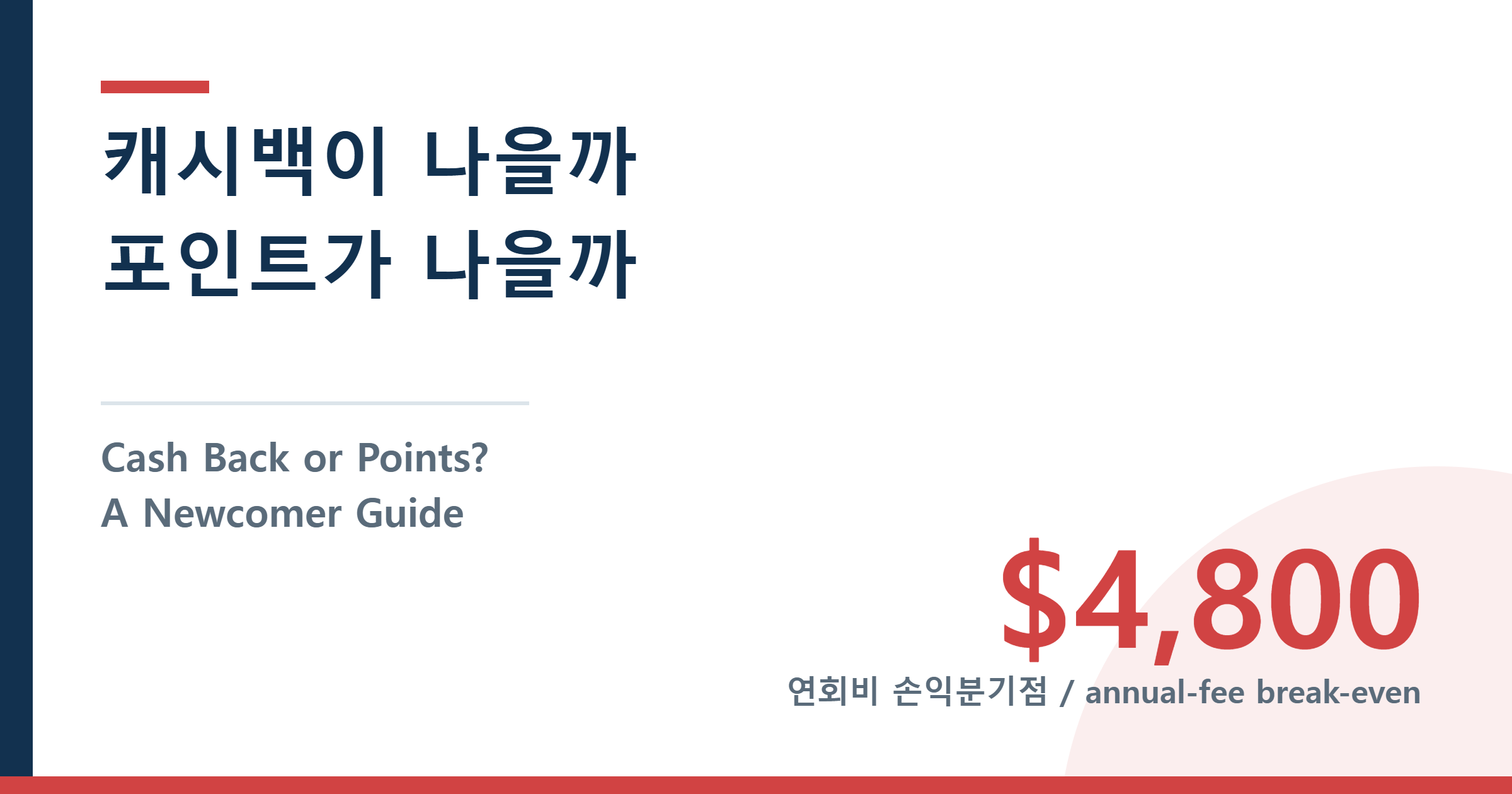
They cross at roughly $4,800 a year. So if you spend $4,800 annually — $400 a month — in the 4% categories, paying the $120 fee wins. Below that, take the no-fee card.
A family of four routinely spends $600–$800 a month on groceries alone, so annual-fee cards often make sense for households. If you live alone, eat out frequently, and rarely do a big grocery shop, a flat-rate no-fee card is easier.
One more factor. Annual-fee cards frequently bundle insurance — rental car coverage, trip cancellation, purchase protection, extended warranty. Rental counter insurance runs $20–$30 a day, so a single trip can recoup the fee. This rarely shows up in the math but the practical value is real.
Three Traps Newcomers Fall Into
Trap 1: The 2.5% Foreign Transaction Fee
Most Canadian credit cards add a 2.5% foreign exchange fee. It is baked into the converted amount, so it is invisible unless you look for it.
Shop Korean sites, use your card while visiting, or subscribe to anything billed in US dollars, and 2.5% applies every time. Spend $3,000 a year in foreign currency and that is $75. Earning 2% cash back while paying 2.5% FX is a net loss.
The fix is a no-FX card. Options like the Scotiabank Passport Visa Infinite waive foreign transaction fees, and the EQ Bank card has no FX fee either. If you travel home regularly, this is a card worth holding.
Trap 2: Welcome Bonus Spending Requirements
“$300 in bonus value on signup” almost always comes with conditions — typically $3,000 in spending within three months.
If your normal spending covers it, great. Manufacturing spending to hit the target defeats the purpose. Check the threshold and compare it against your actual three-month spending before applying.
Trap 3: Applying for Several Cards in Quick Succession
Every application records a hard inquiry, and several in a short window will lower your score. Chasing multiple welcome bonuses early in your time here is risky. Leave at least three to six months between applications.
Recommended Setups by Situation
| Situation | Suggested setup | Why |
|---|---|---|
| First 6 months in Canada | One secured or newcomer card | Building history is the only goal |
| Year 1–2, single | No-fee flat 1.5% cash back | Simple, no fee risk |
| Year 1–2, family | $120-fee 4% grocery card | Grocery spending recovers the fee |
| Frequent trips home | No-FX card + cash back card | Avoiding 2.5% saves the most |
| Score above 700 | Premium card + no-fee backup | Adds insurance coverage |
A two-card setup is usually the efficiency sweet spot: a primary card for high-rate categories and a flat-rate card for everything else. Beyond three cards, the admin burden outweighs the gains.
Frequently Asked Questions
Q. Does closing a credit card lower my score? It can. Your total limit falls, raising utilization, and your average history shortens. Keep no-fee cards rather than closing them. When retiring an annual-fee card, ask for a product change to a no-fee card at the same issuer to preserve the history.
Q. Does adding my spouse as an authorized user build their credit? Some issuers report to the authorized user’s file, but coverage and weight vary. Having your spouse open a card in their own name is the reliable route.
Q. Is cash back taxable? Cash back on personal spending is treated as a purchase discount and is not taxable. Rewards on expenses claimed as business costs may differ — check with an accountant.
Q. Does requesting a limit increase hurt my score? Not if the issuer treats it as a soft inquiry. Ask “Is this a hard or soft inquiry?” first. A higher limit lowers utilization, which usually helps.
Q. Where can I check my score for free? Borrowell and Credit Karma offer free access via soft inquiry, with no score impact. Some bank apps include it too.
Summary
Early on, the purpose of a credit card is history, not rewards. Start with a secured or newcomer card, pay in full monthly, stay under 30% utilization, and within six to twelve months your options open up.
Once you reach the rewards stage, the test is single: do you spend $4,800 a year in the 4% categories? Above that, take the annual-fee card. Below it, take the no-fee flat-rate card.
And if you travel home, deal with the 2.5% foreign transaction fee first. It often saves more than any cash back rate.
That completes this three-part series on Canadian banking basics — fees, savings, and cards. Taxes and investing continue in the RRSP and TFSA articles.
Related Reading
- Paying Canadian Bank Fees Every Month? Here’s How to Get to $0 — 4 Methods That Actually Work
- Best High-Interest Savings Accounts in Canada — HISA Comparison (2026)
- RRSP Contribution Limit 2026: How to Check Your Limit and Maximize Your Tax Refund
- 3 Common TFSA Mistakes: Over-Contribution, Re-Contribution Timing, and What to Do When You Leave Canada
- Bank of Canada Holds at 2.25% Again — What It Means for Your Mortgage Renewal, HISA, GIC, and Rent